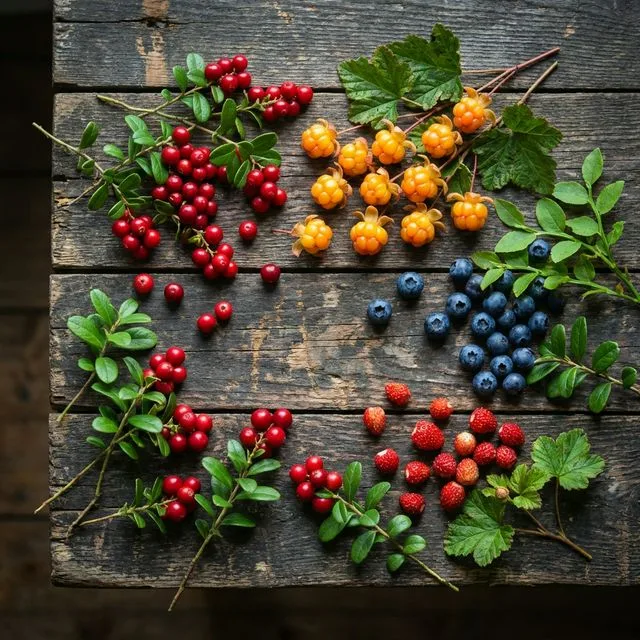
Nordic nature might not provide the longest growing season, but what it lacks in length it makes up for in quality. Northern berries, ripened under the midnight sun, develop intense flavors you simply don't find in berries from warmer climates.
These berries have sustained Nordic populations for centuries. They're packed with nutrients, naturally preserved well, and absolutely delicious. Understanding them connects you to fundamental Nordic food traditions.
Lingonberries: The Nordic Staple
If you know one Nordic berry, it's probably lingonberries (lingon in Swedish, tyttebær in Norwegian). These small, red berries grow wild across Scandinavia and have been a dietary staple for generations.
Season: Lingonberries ripen in late summer to early fall, typically August through October depending on location.
Flavor profile: Tart and slightly bitter when raw, lingonberries have a unique flavor that's both sharp and fruity. They're too sour to eat fresh in large quantities but transform beautifully when cooked with sugar.
Traditional uses: Lingonberry jam (sylt) is the classic accompaniment to Swedish meatballs, but that's just the beginning. Lingonberries pair beautifully with game meats, and can be served with venison, wild boar, or elk. They're also fantastic in desserts, from cheesecake to ice cream.
Preservation: Raw-stirred lingonberries (rårörda lingon) are a traditional preservation method. The berries contain benzoic acid, a natural preservative, so they can be stored just mixed with sugar without cooking. Standard jam-making also works beautifully.
Finding them: Frozen lingonberries are increasingly available internationally. Ikea often carries lingonberry jam. If you can't find them, cranberries make a reasonable substitute, though they're less complex in flavor.
Cloudberries: The Golden Treasure
Cloudberries (hjortron in Swedish, multe in Norwegian) are legendary in Nordic cuisine. These amber-colored berries grow in Arctic bogs and are notoriously difficult to cultivate, making wild-picked cloudberries a prized delicacy.
Season: Cloudberries ripen in July and early August, a brief window that makes them even more special.
Flavor profile: Sweet-tart and distinctly tropical, cloudberries taste nothing like what you'd expect from a Nordic berry. Think apricot meets raspberry with a hint of honey.
Traditional uses: Cloudberry jam is considered the finest of Nordic preserves, often saved for special occasions. Cloudberries with vanilla ice cream and fresh waffles is a classic Norwegian dessert. In Sweden, cloudberry cream (hjortronkräm) is served on special occasions.
Preservation: Cloudberries make exceptional jam. They can also be frozen, though they become mushy when thawed (fine for jam or desserts, not for eating whole). Some people preserve them in sugar syrup.
Finding them: Cloudberries are expensive and hard to find outside Scandinavia. Frozen cloudberries or cloudberry jam occasionally appear in specialty stores. There's no real substitute - cloudberries are unique.
Bilberries: The Wild Blueberry
Bilberries (blåbär in Swedish, blåbær in Norwegian) are wild cousins of cultivated blueberries. They're smaller, darker, and more intensely flavored than commercial blueberries.
Season: Bilberries ripen from mid-July through August, sometimes into early September.
Flavor profile: More complex and intense than commercial blueberries, bilberries are sweet with a slight tartness. They have a richer, more "wild" flavor.
Traditional uses: Bilberry soup (blåbärssoppa) is a refreshing summer drink, served cold or warm. Bilberry pie is a classic, as is bilberry jam. Many Scandinavians eat bilberries fresh with milk and sugar or on pancakes.
Preservation: Bilberries freeze excellently and make wonderful jam. Because they're quite sweet, they need less sugar than many other Nordic berries.
Finding them: Outside Scandinavia, wild blueberries (which grow in parts of North America) are the closest relative. Regular blueberries work in recipes calling for bilberries, though the flavor will be milder.
Sea Buckthorn: The Vitamin Bomb
Sea buckthorn (havtorn in both Swedish and Norwegian) grows along Nordic coastlines. These bright orange berries are incredibly sour and packed with vitamin C.
Season: Sea buckthorn berries ripen in late summer and fall, typically August through October.
Flavor profile: Extremely tart and acidic with a unique citrus-like flavor. They're too sour to eat raw but have an incredible, complex taste when processed.
Traditional uses: Sea buckthorn juice is the most common use. Mixed with other juices or sweetened, it makes a refreshing and impossibly healthy drink. Sea buckthorn jam pairs well with fish and white meats. It's also used in smoothies and desserts.
Preservation: Sea buckthorn freezes well. Juice can be made from fresh or frozen berries and kept refrigerated or frozen. The berries are too sour for most people to enjoy fresh.
Finding them: Sea buckthorn products are becoming trendy internationally due to their high nutrition. Look for juice or frozen berries in health food stores. There's no good substitute for the unique flavor.
Wild Strawberries: Summer's Delicacy
Wild strawberries (smultron in Swedish, mark Jordbær in Norwegian) are tiny compared to commercial strawberries but pack incredible flavor.
Season: Wild strawberries ripen in midsummer, typically late June through July.
Flavor profile: Intensely sweet and aromatic, with a concentrated strawberry flavor that makes commercial berries taste watery in comparison.
Traditional uses: Eaten fresh with cream and sugar, or on vanilla ice cream. Some make jam, though wild strawberries are so perfect fresh that preserving them seems wasteful.
Preservation: Wild strawberries freeze reasonably well. Jam is possible but requires patience due to the small size. Most people just eat them fresh.
Finding them: Wild strawberries occasionally appear at farmers markets in North America and Europe. No cultivated variety truly matches their flavor.
Elderberries: The Folk Medicine Berry
Elderberries (flä der in Swedish, hyll in Norwegian) grow wild throughout Scandinavia and have been used for both food and medicine for centuries.
Season: Elderberries ripen in late summer, typically August through September.
Flavor profile: Dark and complex, somewhat wine-like. Raw elderberries are mildly toxic and must be cooked.
Traditional uses: Elderberry soup is traditional, as is elderberry juice. Historically used for colds and flu, elderberry products remain popular in Nordic wellness culture.
Preservation: Elderberry juice and syrup keep well. The berries can be frozen.
Finding them: Elderberry products are widely available due to their health reputation. Fresh or frozen berries can be found in some stores and markets.
Foraging Rights
In Sweden, Norway, and Finland, "everyman's right" (allemansrätt) allows anyone to pick wild berries on both public and private land. This tradition means berry picking isn't just for those with berry patches - it's a national heritage accessible to everyone.
If you're visiting Scandinavia during berry season, try foraging. It connects you to Nordic nature and food culture in a direct, meaningful way.
Using Nordic Berries
These berries transform everyday foods. A spoonful of lingonberry jam elevates simple oatmeal. Bilberries make pancakes special. Cloudberry jam on vanilla ice cream creates an unforgettable dessert.
Don't save these berries only for Nordic recipes. They work beautifully in any cuisine that uses berries. Put lingonberries in a turkey sandwich. Add bilberries to your morning yogurt. Use sea buckthorn juice in cocktails.
Nordic berries remind us that the best ingredients often come from the wild, that seasonality creates anticipation and appreciation, and that simple foods become extraordinary when paired with nature's finest offerings.
Keywords: Nordic berries, lingonberries, cloudberries, bilberries, Scandinavian ingredients, wild berries, berry foraging, Nordic nature
Meta Description: Complete guide to Nordic berries: lingonberries, cloudberries, bilberries, sea buckthorn, and more. Learn when they're in season, how to preserve them, and recipe ideas.