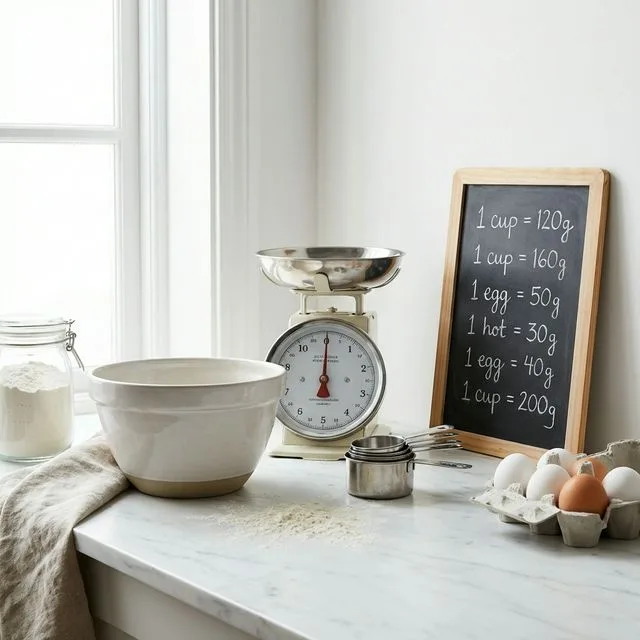
You find a perfect recipe online. Then you see it: "2 cups flour, 8 oz butter, 1 stick butter." If you're used to grams and milliliters, this is frustrating. If you're used to cups and ounces, metric recipes feel equally foreign.
Unit conversion shouldn't stop you from cooking great food. Understanding the basics and using the right tools makes any recipe accessible.
The Two Systems
Metric uses grams for weight and milliliters/liters for volume. It's decimal-based and logical. 1000ml = 1L. 1000g = 1kg. Simple math.
Imperial uses ounces, pounds, cups, tablespoons, and teaspoons. It's less logical but deeply embedded in American cooking. Conversions aren't decimal: 16 tablespoons = 1 cup, 8 fluid ounces = 1 cup, 16 ounces = 1 pound.
Most of the world uses metric. The US primarily uses imperial. The UK uses a mix. Nordic countries are fully metric.
Volume vs Weight
This is crucial: volume and weight are different.
Volume measures space: cups, milliliters, tablespoons. A cup of feathers and a cup of lead occupy the same space but weigh vastly different amounts.
Weight measures mass: grams, ounces, pounds. 100g of flour and 100g of water weigh the same but occupy different volumes.
For liquids, volume and weight conversions are straightforward because water-based liquids have predictable density. 1ml of water weighs 1g. 1 cup (240ml) of water weighs 240g.
For solids, it's complicated. 1 cup of flour doesn't have a fixed weight. It depends on how you measure - scooped, spooned, sifted. This is why professional bakers use weight for dry ingredients.
Essential Conversions
Volume:
- 1 cup = 240ml
- 1 tablespoon = 15ml
- 1 teaspoon = 5ml
- 1 fluid ounce = 30ml
Weight:
- 1 ounce = 28g
- 1 pound = 454g
- 1kg = 2.2 pounds
Common ingredients (approximate):
- 1 cup all-purpose flour = 120-130g
- 1 cup sugar = 200g
- 1 cup butter = 227g (also = 2 sticks = 8 oz)
- 1 tablespoon butter = 14g
These are approximations. Flour especially varies based on measurement method.
Why Weight Is Better
For baking, weight measurements are more accurate than volume.
When a recipe says "1 cup flour," how you fill that cup dramatically affects the amount. Scoop directly from the bag and you might get 150g. Spoon it in gently and you might get 120g. That's a 25% difference - enough to ruin bread or cake.
"130g flour" is always 130g, regardless of how you get it into the bowl.
This is why European recipes use weight. It's more precise and reliable.
Using RecipeBase's Conversion Tools
RecipeBase handles conversions automatically.
Automatic conversion: Set your preferred measurement system in settings. Any recipe automatically displays in your preferred units. An American recipe with cups converts to grams. A Nordic recipe with grams converts to cups.
Toggle between systems: Even with a preference set, you can toggle any recipe to see both metric and imperial. Useful for learning or when a specific measurement makes more sense.
Smart conversions: The system knows that converting butter is different from converting flour. It uses ingredient-specific conversion factors for accuracy.
Practical Tips
Invest in a kitchen scale: Cheap, accurate, and transforms your cooking. Measure dry ingredients by weight whenever possible.
Learn the common ones: Memorize the conversions you use most. 1 cup = 240ml, 1 tablespoon = 15ml, 1 ounce = 28g. These cover most situations.
Understand your recipes: If a recipe is from the US, it's designed around volume measurements. Converting to weight is more accurate, but the recipe was developed with cups. If a recipe is European, it's designed around weight. Converting to volume works but isn't ideal.
When precision matters: Baking requires precision. Use weight. Cooking (soups, stews, sauces) is more forgiving. Volume measurements work fine.
Butter is special: In the US, butter is sold in sticks. 1 stick = 1/2 cup = 8 tablespoons = 4 oz = 113g. Many American recipes call for "sticks" of butter. If you don't have sticks, use weight.
Common Confusions
Fluid ounces vs ounces: Fluid ounces measure volume. Ounces measure weight. They're different. 8 fluid ounces of water weighs 8 ounces, but 8 fluid ounces of honey weighs more than 8 ounces.
UK vs US measurements: UK and US cups are slightly different. UK tablespoons are also different. If a recipe is British, be aware conversions might not be exact.
Packed vs unpacked: "1 cup packed brown sugar" means you press it down. "1 cup flour" means you don't. This affects weight significantly.
Building Intuition
Over time, you'll develop a feel for conversions.
You'll know that 100g is a bit less than half a cup for most ingredients. 500ml is about 2 cups. 200°C is about 400°F.
This intuition makes cooking easier. You can glance at a recipe and know roughly what the amounts mean, even in unfamiliar units.
The Real Solution
The best solution is using recipes in your preferred measurement system. But that's not always possible.
Second best is automatic conversion tools like RecipeBase provides. They handle the math, account for ingredient differences, and let you focus on cooking.
Third best is learning the essential conversions and using a calculator or conversion chart.
Worst is guessing. Don't guess. Measurements matter, especially in baking.
Moving Forward
If you're metric-native, start weighing ingredients. It's more accurate and most modern recipes provide weights.
If you're imperial-native, consider learning metric for baking. It's simpler math and more precise.
Either way, use tools to bridge the gap. Don't let measurement systems limit which recipes you can cook.
The goal is cooking great food, not doing mental math. Let technology handle conversions so you can focus on technique, flavor, and enjoying the process.
Keywords: unit conversion, metric to imperial, recipe measurements, cooking conversions, kitchen measurements, baking measurements, cups to grams
Meta Description: Master recipe unit conversions between metric and imperial. Learn essential conversions, understand volume vs weight, and use tools to cook any recipe regardless of measurement system.